Background
In many companies the pattern is the same: management hears "AI" everywhere, the team doesn't know where its own leverage is, and in the end there are a couple of people who briefly tried ChatGPT. What's missing is a shared language, an honest sense of scope — and a concrete entry point that doesn't stop at a tool demo.
That's what we run workshops for. Daniel Jung Media was one of more than five cases by now; all of them had the same brief: assume no prior knowledge, skip slide marathons, produce real results by the end of the day.
Solution
A workshop day deliberately split into two very different halves.
- Morning: fundamentals without prior tech knowledge. What is AI today, really, and what isn't it? How do chat interfaces, autonomous routines and co-work modes differ? When is AI worth it, when is it overengineering? Content-wise we centre on the Claude ecosystem: Claude as a chat model, Claude CoWork for sustained collaborative work, Claude Code for development and engineering tasks, Claude Design for structured visual work, Claude Desktop as the everyday workbench, plus Routines, Tasks and Live Artifacts as reusable building blocks.
- Afternoon: real-world problem work. Participants bring their own topics — research workflows, content pipelines, internal processes, tool chains. We work on solutions together, partly live on screen, always aiming for a concrete artefact at the end.
The trick: no dry exercises. Bring your own problem, leave with your own first solution.
Outcome
Over five companies trained so far, Daniel Jung Media among them. Teams are markedly more AI-ready than before: shared foundation, clearer ideas about where AI fits the business, concrete first solutions. People with no tech background produce their own results in the room — and several workshops have since spawned independently built websites and internal tools.
A voice from the workshop
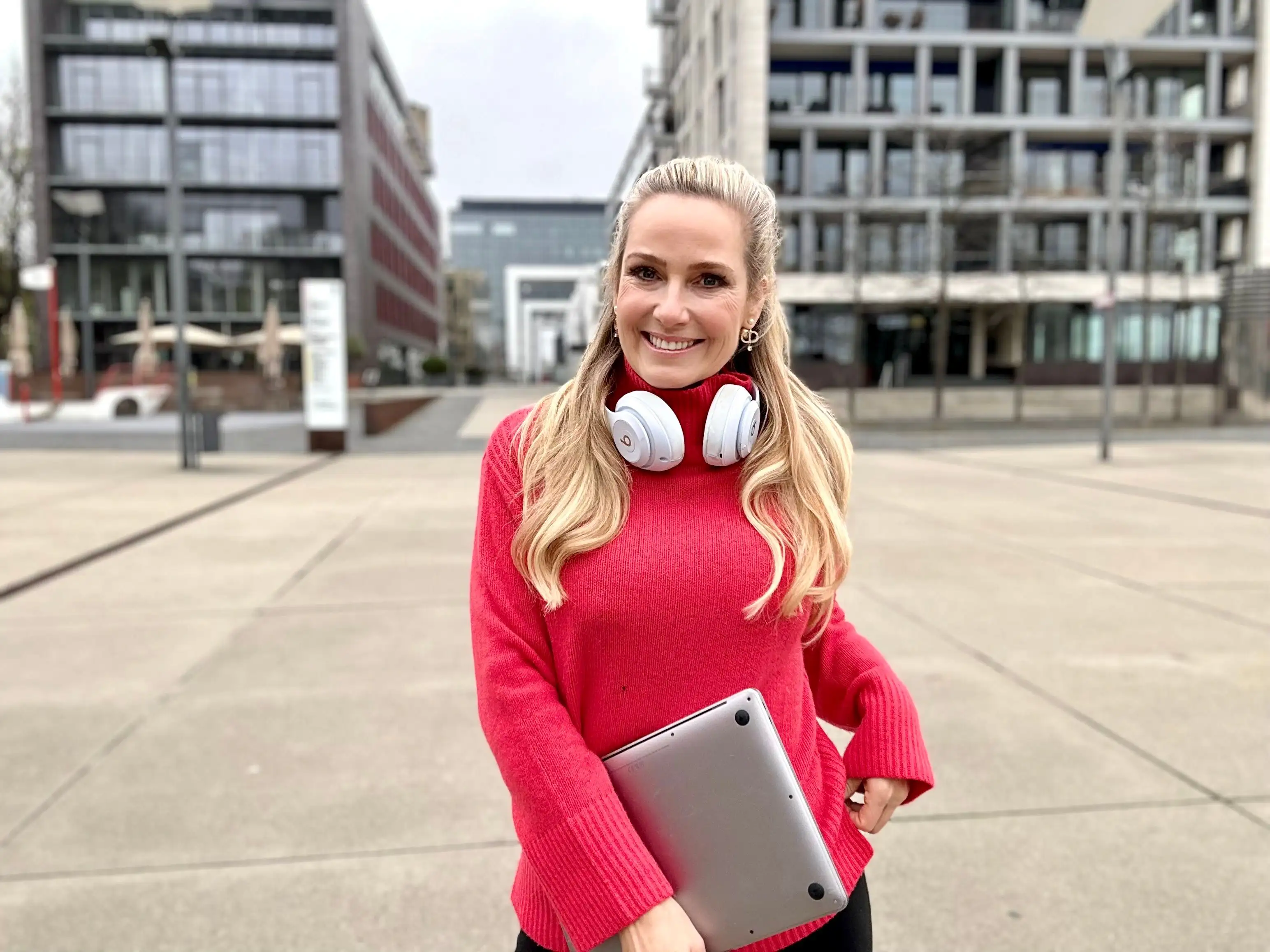
In Christian's course I learned how to actually use Claude productively. From CoWork to live artefacts to my own AI morning newsletter that kept us company every morning for the week after the course. Exactly that transfer into daily work made the difference: instead of abstract theory, I walked away with concrete workflows that worked immediately. Christian manages to demystify the tools without taking away their fascination — at the end you don't just use AI, you really understand it. Clear recommendation for anyone who wants to get beyond playing with prompts.
Why this fits us
Plenty of people offer AI workshops these days — most stop at showing tools. We aim somewhere else: the team should be able to keep working afterwards, the line between hype and real applicability should be visible, and the content shouldn't be obsolete two quarters later. We live in the ecosystem we teach — and work productively every day in Claude, Claude Code, Claude CoWork and the corresponding routines.